Bangkok vs Kuala Lumpur for Digital Nomads: An Honest Comparison from Two Canadians in Their 40s
The Bangkok vs Kuala Lumpur debate for digital nomads comes down to cost, coworking, visa flexibility, and quality of life – here is our honest take after living in both. We have spent over five months across both cities in the past two years. Not as tourists passing through. As people who needed to actually work, cook, sleep, and function. Bangkok for a combined three months across two separate long stays. Kuala Lumpur for four months. If you want to know how we even got to Asia in the first place, read our WestJet Premium Economy review where we covered the flight that started our 202-day journey. This is our honest take on both cities.
Connectivity is everything for nomads. See our Trip.com eSIM review across six Asian countries.
Bangkok Vs Kuala Lumpur: Who This Post Is For
Before anything else: context matters here. We are two Canadians in our late 30s and mid 40s. We work remotely. We are well past the point of seeking out rooftop parties, hostel common rooms, or Khao San Road energy. What we want from a base is quiet productivity, good food within walking distance, a clean place to sleep, and enough interesting things nearby to not feel trapped.
If you are in your 20s and want nightlife, cheap street food at 3am, a social scene, and the feeling of being somewhere completely electric and foreign, Bangkok is almost certainly your city. Seriously. It is extraordinary for that life stage and we say that without any hesitation.
This post reflects our experience specifically. Where we land may not be where you land. We will flag throughout where we are speaking from personal taste versus where the facts speak for themselves.
The Fast Answer
| Bangkok | Kuala Lumpur | |
|---|---|---|
| Monthly rent (downtown, 1 bed) | $1,200–$1,700 CAD | $1,400–$1,800 CAD |
| Visa-free stay (Canadians) | 60 days + 30 day extension | 90 days |
| Internet speed (avg fixed broadband) | ~220 Mbps | ~140 Mbps |
| Rail network | 90+ stations, multiple lines | 170+ stations, 11 lines |
| English proficiency | Good in expat areas | Excellent everywhere |
| Best for | Tourists, 20s energy, short stays | Long-term nomads, 30s+ |
Our verdict: KL for nomads in their 30s and 40s. Bangkok for tourists and younger travellers. Here is why.
Visa: The Biggest Practical Difference
This one is fact, not personal preference.
As a Canadian, you get 60 days visa-free in Thailand, extendable once by 30 days at an immigration office for around $70 CAD. After that you need to leave. We did a visa run ourselves during our first long Bangkok stay. It is exactly as annoying as it sounds: a full day trip to the border, a stamp, back again. Thailand has also tightened enforcement on repeat visitors in 2026, flagging passports with multiple exemption entries in a rolling 12-month period.
In Malaysia, Canadians get 90 days visa-free, no extension needed, no border run. For a two or three month stay, KL wins on this alone. You land, you work, you leave when you are ready.
Accommodation: What Your Money Gets You
Bangkok
A decent downtown condo with a pool and gym runs $1,200 to $1,700 CAD per month. The keyword is downtown. We made the mistake on our first long stay of booking in Khet Huai Khwang to save money. We regretted it almost immediately. The commute into the areas we actually wanted to spend time in ate into our days constantly. We were spending more on Grab than we saved on rent. The studio had no separate living area, so working and sleeping happened in the same spot. It got claustrophobic fast. We tried working in the communal area which had a great view, but the wifi was too slow to rely on for actual work.
The lesson with Bangkok: pay for central. The money you save on a peripheral location comes back out in transport costs and lost time.
Kuala Lumpur
KL prices jumped noticeably between our 2025 and 2026 stays. In 2025 we found a solid downtown place for around $1,000 CAD. In 2026 the same standard was running $1,700 to $1,800 CAD. We ended up finding a two-bedroom in Bukit Bintang for $1,500 CAD: walking distance to TRX and Pavilion, close to the MRT, weekly cleaning, gym, pool, and an on-call concierge via WhatsApp.
The two-bedroom mattered more than we expected. We had tried a one-bedroom for a week beforehand and the beds were too small for both of us. Having the extra room from the start made the stay actually comfortable. The space was good and the views were great.
The downside: we found mold in the bathroom. Shower walls, ceiling, murky glass at the bottom. At $1,500 CAD a month you expect better. Inspect thoroughly before you commit to anywhere.
Internet: Bangkok Wins on Paper
Bangkok averages around 220 Mbps on fixed broadband. KL averages around 140 Mbps. Both are fast enough for video calls, uploads, and working without issues, but Bangkok has a measurable edge on raw speed.
The catch, and this is from personal experience: your individual condo wifi matters far more than city averages. Our Bangkok communal workspace was painfully slow despite the city’s strong infrastructure. Always test the actual connection before you commit to a monthly stay. Both cities have solid mobile SIM options as backup.
Transport: Both Cities Will Frustrate You
People sometimes claim KL’s metro is better than Bangkok’s. The facts are more nuanced than that.
Bangkok has over 90 rail stations across multiple lines including the BTS Skytrain, MRT Blue and Purple Lines, and newer Yellow and Pink monorail lines. KL has 170+ stations across 11 lines including MRT, LRT, monorail, and commuter rail. On paper KL’s network is larger. In practice, both cities have the same problem: the rail does not go where you need to go for daily nomad life, so you end up in Grab, and Grab means traffic.
Bangkok’s traffic consistently ranks among the worst in Asia. We were regularly surprised to find that walking 15 minutes was faster than a 15-minute Grab during peak hours. KL’s traffic is equally gridlocked. We needed Grab just as often in both cities.
Our personal experience was that KL’s rail coverage around Bukit Bintang and KLCC felt slightly more useful for daily nomad life. But we are talking at the margins. Neither city lets you get by on metro alone. Both cities are also hot enough that walking more than a few blocks during the day is genuinely unpleasant.
Food: This Is Where Personal Preference Matters Most
We want to be upfront: this section is the most subjective part of this entire post. Please read it through that lens.
Bangkok Food
Bangkok’s food is beloved by millions of people for very good reason. The city consistently ranks among the world’s top food destinations and has more Michelin Guide recognitions than any other Southeast Asian city. Objectively, the food scene is extraordinary. If Thai food is your thing, Bangkok will not disappoint you.
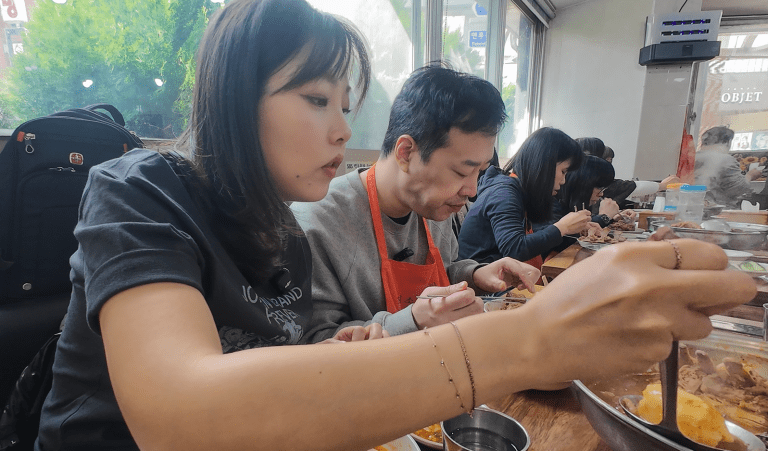
For us personally, it was inconsistent. The highs were genuinely incredible. Yaowarat Chinatown has some of the best noodles we have eaten anywhere. Pu Pad Pong Curry, crab in a golden curry sauce, is something we still think about. After You dessert cafe for mango sticky rice kakigori is a stop we will make every time we visit: shaved ice with sticky rice through it, one of those things that sounds simple and is not. Khao Soi, Som Tam, fresh night market fruit, the food trucks outside our condo every morning and night with no repeats: Bangkok at its best is extraordinary.
Where it fell short for us personally was consistency. The strong aromatics of some Thai dishes did not always match our palates. The Japanese and Korean restaurants consistently missed for us: too sweet, something lost in translation. We know plenty of people who love Thai food unreservedly and eat their way happily through every meal. This is a taste preference issue, not a quality judgment.
Bangkok is also one of the world’s great nightlife cities. The street scenes, the late-night eating culture, the energy after dark: if that is what you are after, Bangkok wins without a contest. For us in our late 30s and mid 40s, that was not the priority.
KL Food
KL’s food hit differently for us, and again this is personal. The mix of Malay, Chinese, and Indian influences creates something we found more consistently satisfying. Nasi Lemak, Laksa, Roti Canai, char siu, Chinese dim sum: almost everything worked for us reliably. Our go-to was Kopi Oriental, which we returned to more times than we can count. Whether KL food would suit you as well depends entirely on your own palate.
One practical tip on groceries: near TRX, Seibu and Mercato run on the pricier side, but after 8pm every day both stores discount their bento boxes by 50%. We picked up quality prepared meals for 15 to 17 ringgit regularly. That kind of daily habit adds up over a long stay.
Prices in 2026
Bangkok felt noticeably more expensive on our return visit compared to the previous year. Accommodation, food, groceries: everything moved up and it was not subtle. We left with mixed feelings about returning for another long stint, which is different from how we felt after the first stay. This is part of a broader trend across Asia: we covered the rising costs in Japan in detail in our post on what the 2026 Japan departure tax means for travellers.
KL accommodation costs also rose significantly between our two visits. But food and grocery prices held steadier and we still felt we were getting genuine value overall.
The Rat Situation (Nobody Writes This)
Bangkok: our first night out, we turned into an alley and made direct eye contact with a large rat. Completely unbothered by us. Jenny no longer wears sandals anywhere in Southeast Asia.
KL: we took a wrong turn one night and walked past a dumpster. Five rats, openly on the garbage.
This is the reality of dense tropical urban environments. Both cities. Stick to the main streets after dark and wear closed shoes.
The Verdict: It Depends on Your Life Stage
KL wins for us, and we want to be specific about who “us” means. We are two Canadians in our late 30s and mid 40s who work remotely and want a liveable, calm, functional base. We are not chasing nightlife. We are not looking for a hostel community or a party scene. We want a comfortable apartment, reliable internet, good food, and a city that does not exhaust us.
If that sounds like you, KL is the better choice.
If you are in your 20s and want energy, want to meet people, want Bangkok’s legendary nightlife, its temples, its chaos, and the feeling of being somewhere utterly unlike anywhere else: Bangkok is not just good, it is probably the best city in Southeast Asia for that life stage. Our verdict does not apply to you and you should go without hesitation.
The honest answer is that both cities are excellent. They are just excellent for different things and different chapters of life.
There is a local joke in KL that residents try to keep the city a secret from foreigners because they do not want people finding out how good it is. After three months there at our particular stage of life, we understand completely.
Have you spent time in both cities? We would love to hear where you landed and what made the difference. Drop it in the comments below.
For a full breakdown of what it actually costs to live and travel across six Asian countries over 202 days, read our complete digital nomad guide to Asia. Planning Korea too? Our Korea travel guide for Canadians has everything you need. Find us on Instagram at @chasing.jenny or follow along on YouTube.
For destination details, check the official tourism site.