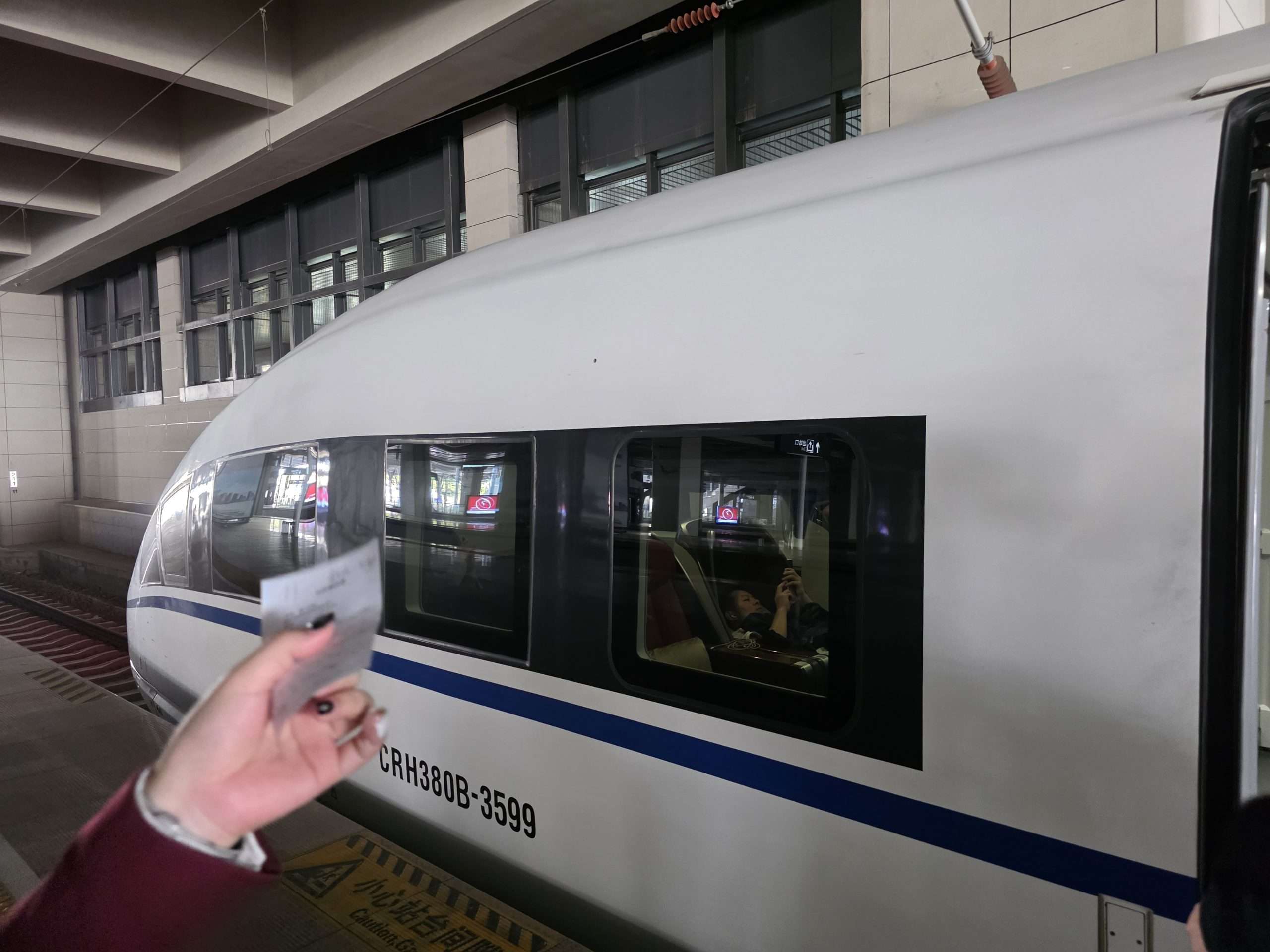
China High-Speed Rail: Second vs First vs Business Class (Honest Review)
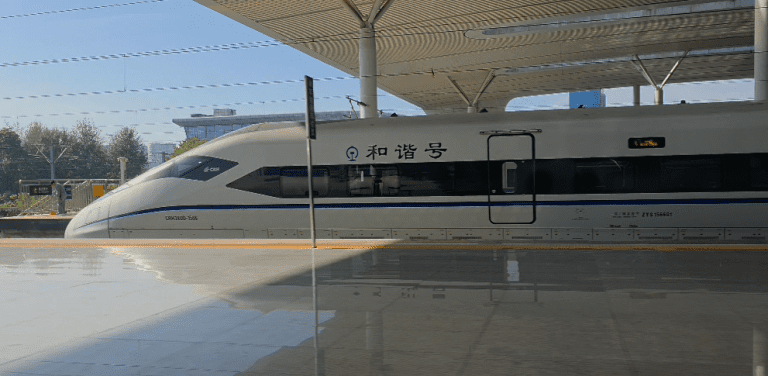
China high speed rail is one of the most impressive transport networks in the world, and the fastest, cheapest way to move between major Chinese cities. Trains run on time. They are clean. They connect almost every city worth visiting. But when you open Trip.com to book, you hit the question every first-timer hits: Second Class, First Class, or Business Class?
We rode all three China high speed rail classes across 50 days and thousands of kilometres. This guide gives you the honest breakdown: what each class actually costs, what you get, which seat to pick, and how to book it as a foreigner.
First Class costs about 20 to 50% more than Second and delivers most of the comfort. Business Class is a different world, and a different price.
What’s in this guide
- Quick answer: which class to book
- What each class actually costs
- Second Class
- First Class
- Business Class
- Seat specs and which seat to pick
- Side-by-side comparison
- How to book (plus luggage, WiFi, food)
- FAQ
Quick answer: which China high speed rail class should you book?
Trip under 2 hours: book Second Class. The price gap does not justify the upgrade for a short hop.
Trip over 3 hours: book First Class, no question. We learned this the hard way on a 5-hour Second Class ride from Shangrao to Xiamen. Never again.
Want a once-in-a-trip experience: try Business Class once. Ian’s parents rode it and came off the train looking like they had just had a spa day.
China high speed rail prices: what each class actually costs
The right class depends as much on price as on duration, and the gap changes wildly by route. On a short hop, First Class costs a few dollars more than Second. On a long haul, Business Class costs five times as much. Here are real 2026 fares on three routes we know.
Fares shift by train, time of day, and how far ahead you book, so treat these as ballpark. Second Class on most routes costs 40 to 50% less than First.
Notice the pattern. Shanghai to Hangzhou, First Class costs about $9 CAD more than Second: a no-brainer. Beijing to Shanghai, Business Class costs $250 CAD more than Second: a treat, not a default.
Second Class: the standard experience
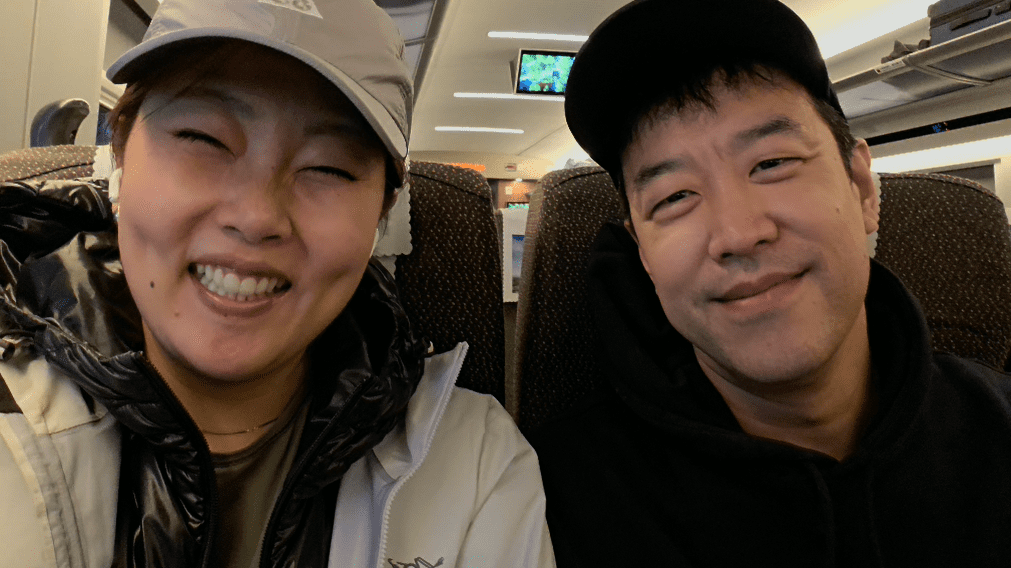
Seat layout: 3+2 (5 seats per row, 42 cm wide). Second Class is how most people ride China high speed rail, and it works fine for short trips. The trains are fast and clean regardless of class. What changes is the seat. Three seats on one side, two on the other. If you land in the middle of the three-seat row, it feels exactly like economy on a budget airline. Functional, not comfortable.
Legroom is acceptable. Noise runs higher than First Class: families, kids, people eating instant noodles. It is not unpleasant, it is just busy. Families love it for the price, so expect a lively carriage. Each row shares one or two power sockets under the seat in front, which is fine for a phone and annoying if three people want to charge at once.
We took Second Class from Shangrao to Xiamen. Five hours. We were trying to save money, and the gap to First Class was big on that route, so we toughed it out. By hour three we both regretted it. By hour five we had agreed to never do a long-haul Second Class again.
Best for: trips under 2 hours, or when the gap to First Class is steep (over $25 CAD).
First Class: the sweet spot

Seat layout: 2+2 (4 seats per row, 47 cm wide). The difference between Second and First is not luxury, it is space. Removing one seat from the row changes everything. No middle seat. Wider seats. Noticeably better legroom. The cabin is quieter, and the seat reclines further, around 60 degrees versus 45 in Second. You can put your arms on the armrests without negotiating with your neighbour. If you are tall or broad, this is where China high speed rail stops feeling tight.
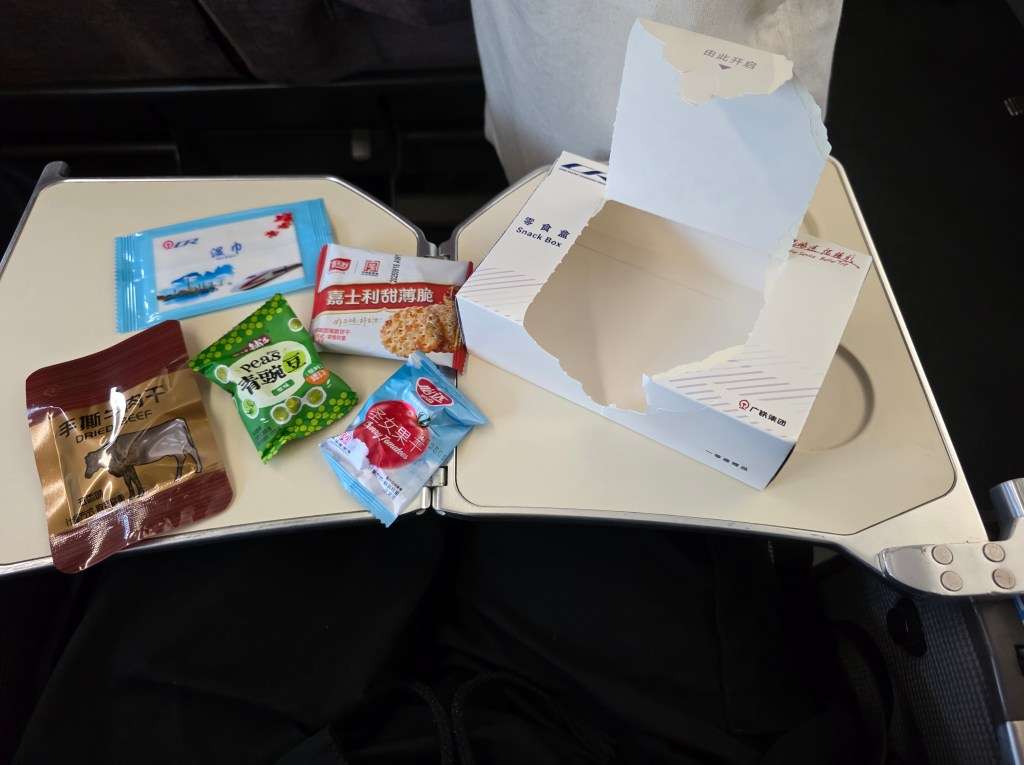
There is also a small snack box: dried beef, crackers, peas, cherry tomatoes. Do not get excited about the food, but it is a nice touch.

Each seat has its own charging outlet and a footrest. On long routes, Beijing to Shanghai is 4.5 hours and Guangzhou to Xiamen is 3.5, that footrest matters more than you would expect.
The gap between First and Second is often small. On many routes it is under $15 CAD. When it is that close, First is the obvious call. When the gap is bigger, it becomes a judgment call on duration.
Best for: any trip over 2.5 hours. Our default for almost every train we booked in China.
Business Class: the VIP splurge
Seat layout: 2+1 or 1+1, lie-flat seats. Business Class on China’s G-trains is a completely different product, and it starts before you board. You skip the main waiting hall for a dedicated VIP lounge with snacks and drinks. An attendant escorts you onto the train before general boarding.
The seats recline fully flat, so you can genuinely sleep. A hot meal is served to your seat, not the dried snack box, an actual meal. When you arrive, someone meets you on the platform to help with luggage.
Ian’s parents rode Business Class on a 4-hour route and came off looking like they had had a rest day. That is the product. It is not just a bigger seat, it is the full premium China high speed rail experience.
The price is steep, typically 4 to 6 times Second Class. For most travellers most of the time, First Class delivers most of the comfort at a fraction of the Business price. But if you are celebrating something, or facing a very long haul, Business once is worth experiencing.
Best for: special occasions, very long routes (4+ hours), or when you just want to feel like a VIP for a few hours.
China high speed rail seat specs and which seat to pick
If you have ever stared at the Trip.com seat map wondering what A, C, D, and F mean, here is the cheat sheet. China high speed rail seats are lettered like a plane, and here is the quirk nobody tells you: there is no E. Here is how the three classes stack up on the specs that actually matter.
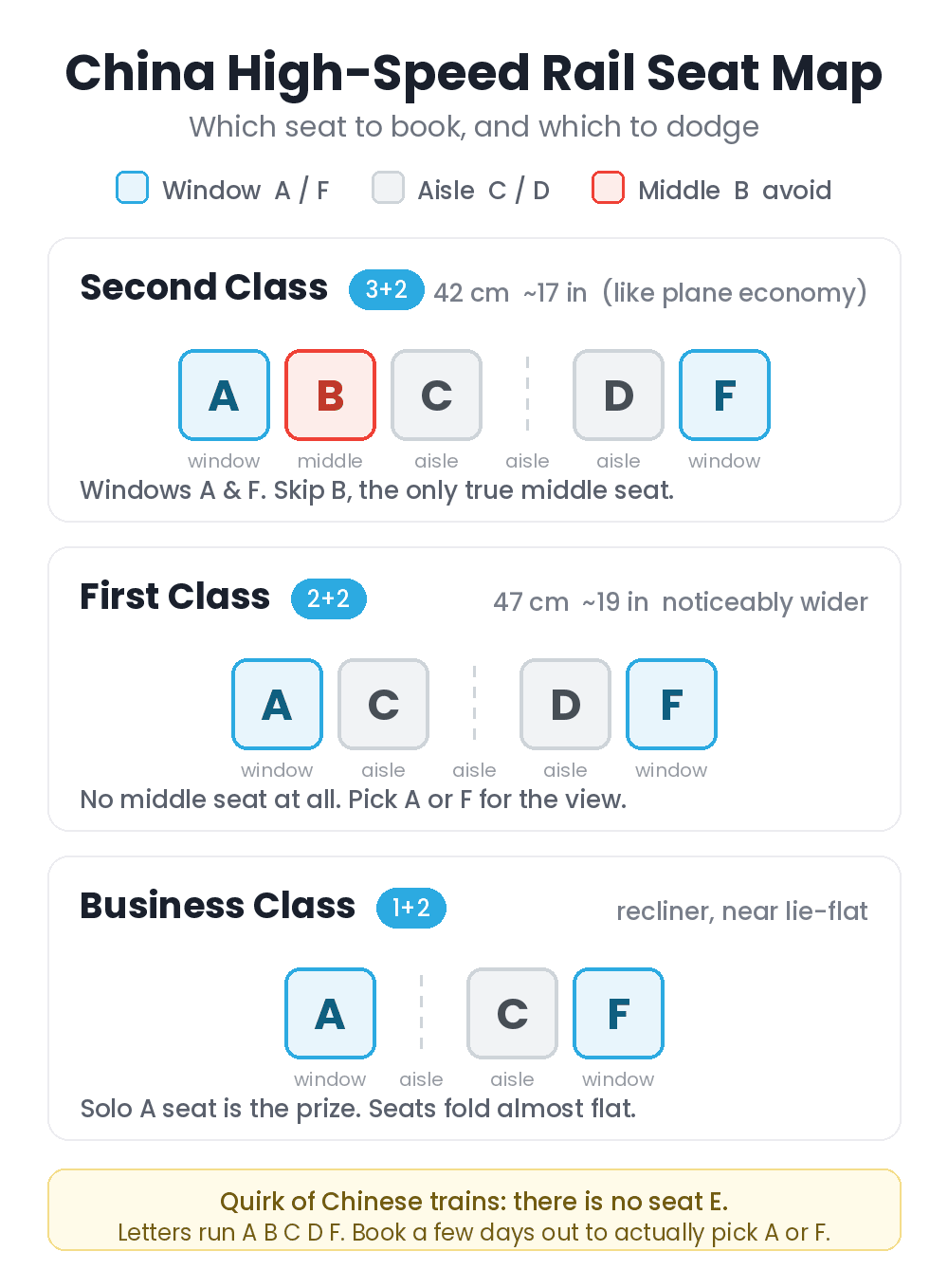
Which seat letter to book
- Window seats are A and F. Best for views and a wall to lean on for a nap.
- Aisle seats are C and D. Best for legroom and getting out fast at a busy stop.
- In Second Class, B is the dreaded middle. Avoid it if you can pick your seat.
- Skip the carriage ends. Rows nearest the doors and toilets get the most foot traffic and noise.
Seat selection is available on Trip.com, but the good window seats go first on busy China high speed rail routes. Book a few days out and you can pick A or F instead of taking what is left.
China high speed rail classes: side-by-side comparison
How to book China high speed rail as a foreigner
Trip.com is the easiest way for foreigners to book China high speed rail. English interface, accepts international credit cards, and the flow is straightforward. Search by city, pick your date, choose your train and class, pay. Collect at the station or scan your passport at the self-service machines. We booked every single ticket on our 50-day trip through Trip.com and had zero issues.
Trip.com lets you ask for adjacent seats on China high speed rail when you book more than one ticket, but it is a preference, not a promise. Some trains show a seat map you can pick from, others just allocate for you. Booking First Class, we asked for two seats side by side every time and never once got them. Book early, pick the seats yourself if the map appears (in First Class the pairs are A+C and D+F), and if you do get split up, most travellers happily swap so couples can sit together.
G, D, and C: which China high speed rail train is which
The letter in front of your train number tells you the type. G-trains are the fastest at up to 350 km/h, and the only ones that carry Business Class. D-trains run a little slower, around 250 km/h, and cover some overnight routes with sleeper berths. C-trains handle short intercity hops like Beijing to Tianjin. The rule for booking is simple: if you want Business Class, pick a G-train. First and Second Class ride on all three.
Trip.com vs the 12306 app
The 12306 app is the official national rail app and it is cheaper, but the interface is in Mandarin and it needs a Chinese phone number to register. Doable with local help. For most travellers, Trip.com is worth the small markup for the convenience. For the full app-and-payments setup, read our China travel apps guide.
Luggage: what you can bring
There is no checked luggage on China high speed rail. You carry everything on. The guideline is 20 kg per adult with each bag no larger than 130 cm total, and in practice nobody weighs your bag at the gate. Small and medium cases go on the overhead racks. Big suitcases go on the larger racks at the end of each carriage, so board a minute early to claim the space.
WiFi, power, and staying connected
Some newer Fuxing trains have free WiFi, but it drops constantly at 300 km/h, so do not count on it. Bring your own data. We used a Trip.com eSIM across Asia and it was the cheapest, most reliable option we found: see our Trip.com eSIM review. For power, Second Class shares a socket or two per row, First Class gives you one per seat pair, and Business Class has one at every seat. Every carriage has a hot-water dispenser, which is why half the train is eating instant noodles.
Food onboard
A snack trolley runs through every train, and longer G-trains have a dining car with hot boxed meals. The food is fine, not memorable. First Class gets the free snack box, Business Class gets a hot meal to the seat. Our move: grab food at the station before boarding, fill a cup at the hot-water dispenser, and skip the trolley prices.
Refunds and changes
Plans shift, and China high speed rail tickets are refundable. Change or cancel before departure through Trip.com or 12306. The fee climbs as departure nears: little or nothing several days out, up to 20% or more in the final hours. Refunds return to your original card. Book with a buffer and you are rarely stuck paying for a ticket you cannot use.
One thing to know: Business Class seats sell out first on popular routes and dates. If you plan to try it, book early. And if you are shaping your wider route, our 50-day China travel guide covers how we planned the whole trip.
China high speed rail vs flying: which should you pick?
China high speed rail often beats flying, and not just on price. For most city pairs under about 1,000 km, the train wins door to door. Stations sit in the city centre, not an hour out like the airports. You show up 30 minutes before departure instead of two hours, skip the security theatre, and walk straight off at the far end with no baggage carousel. Beijing to Shanghai runs about 4.5 hours by China high speed rail versus 2.5 in the air, but once you add airport transfers, check-in, and security, the train usually wins on total time and always wins on stress.
The ride is better too. You get big windows, a smooth track, and room to walk around, not a cramped cabin at 35,000 feet. Fly only for the long diagonal hops, like Beijing to Kunming, where the raw distance turns the train into an overnight commitment.
China high speed rail FAQ
Is First Class worth it on China high speed rail?
On any trip over 3 hours, or whenever the gap to Second Class is under about $15 CAD, yes. You lose the middle seat, gain width and legroom, and the cabin is quieter. On a short hop with a big price gap, Second Class is the smart pick.
Can foreigners book China high speed rail?
Yes. Book on Trip.com in English with an international card. You collect the ticket, or scan your passport, at the station. No Chinese bank account or phone number needed.
Do you need your passport to ride?
Yes. Your passport is your ticket. Use the same passport you booked with, and scan it at the gate to get on the platform. Keep it handy, you will show it more than once.
Is there WiFi on China high speed rail?
Some Fuxing trains have free WiFi, but it is unstable at high speed. Bring an eSIM or a local SIM so you are not relying on it.
What is the luggage limit?
About 20 kg per adult, carried on, with no checked-bag service. Overhead racks handle carry-on cases, and larger bags go on the racks at each carriage end.
How early should you book Business Class?
A few days ahead on popular routes and dates. Business Class has the fewest seats and sells out first, so it is the one class you cannot count on booking last minute.
Is the train or flying better in China?
For trips under about 1,000 km, take the train. China high speed rail drops you in the city centre, needs far less waiting, and runs on time. Fly only for the longest cross-country routes where distance makes the train an overnight trip.
Five quick tips for your first China high speed rail ride
- Arrive 30 minutes early. Security and passport checks at big China high speed rail stations take time.
- Screenshot your ticket and seat number. Station WiFi is patchy and the departure boards move fast.
- Board from the right carriage. Your coach number is on the ticket, and the platform is very long.
- Bring snacks and a refillable cup. Every China high speed rail carriage has a free hot-water dispenser.
- Keep your passport in hand. You scan it at the gate, and staff may check it again onboard.
Quick recap of who each class suits:
- Second Class: short hops and tight budgets.
- First Class: almost everyone, almost every route.
- Business Class: long hauls and special occasions.
First Class is the default. It costs a little more than Second and fixes everything that makes a long ride tiring. Save Business for a once-in-a-trip splurge, and only settle for Second on short hops.
Watch us ride all three classes on YouTube, and follow us on Instagram at @chasing.jenny for more from our 50 days across China.
For station and route reference, the independent rail guide at Seat 61 is the gold standard.
Related: Only in China for a short stay? See if you can enter on the China 240-hour visa-free transit and ride the rails visa-free for up to 10 days.